We were a vibrant, profitable company from 1981 to 1985, and then we tipped right over into losing $50 million a month... We had been profitable from the day we started until American came at us with Ultimate Super Savers.
Donald BurrFounder and CEO, People Express Airlines
t is the winter of 1984, and there is a little airline that is all the rage.
It flies out of a former freight terminal that has somehow become the busiest gateway at Newark International Airport. The company is barely four years old and already, by one account, "the fastest-growing airline in the annals of aviation" — its traffic doubling year over year, with the lowest per seat-mile cost in the business. Harvard Business School teaches it as a case and pronounces it "the most interesting company in America today." The market has paid more than 40× earnings for it: [the multiple not of an airline but of a new kind of company that merely happens to use airplanes]. And the founder — Harvard MBA, no secretaries, no assigned offices — can't even be interviewed in one sitting; there are simply too many interruptions.
"It's like this all the time," says Don Burr, chairman and president of People Express. He calls this office mania "part of the condition for creativity. It's a young and entrepreneurial company, and that's the way you always want it to be." And they are building a hit product, he adds, tilting back in his scarlet, cushioned chair. "We're sold out every day. We're sold out before the store even opens."
The stock has more than doubled in a year, and everyone who works here owns a piece of it — they have to. Employment comes with a requirement to buy 100 shares, sold at a 70% interest-free discount through payroll deductions, so that the 1,200 "racehorse types" who hired on for less and work harder for it now hold, on average, $60,000 of stock apiece, up from $20,000 a year ago. The once schoolteachers, anthropologists, and art historians recruited by Burr are thriving in a company that has no secretaries or plush offices, and will tell you, along with the company's CFO, that they are all "in this together."
The logic behind it is airtight, or seems to be. The lowest costs in the business buy the lowest fares in the business; the lowest fares fill the planes; full planes buy more planes; and the legacy carriers, fat with their hubs, their union scale, their wide-body debt, cannot chase down the fares without bleeding to death. People Express has built a machine the incumbents cannot match. The future of flying has already been decided, and it was decided in a converted freight terminal in Newark.
It is, in the winter of 1984, the most obvious thing in the world.
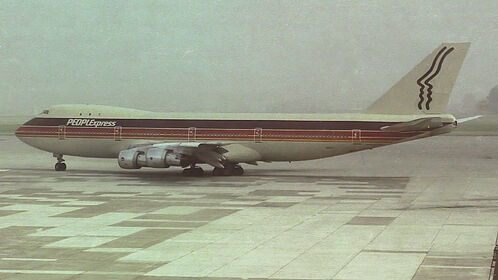
What nobody in Newark is watching closely enough is American Airlines. While People Express sells two fares and serves coffee, American under Robert Crandall has been building the machinery of yield management — a way to sell the same seat at many prices at once, fence the cheapest behind advance-purchase and Saturday-night rules, and release them only a few at a time. On January 17, 1985, American points it straight at People Express: a fare called the Ultimate Super Saver, priced below People's own, on about a third of its seats — available to precisely the leisure travelers who were People's entire business.
By the autumn of 1986 People Express was the fifth-largest carrier in the country, flying close to a million passengers a month, but now it was also a corpse: $600M in long-term debt, perhaps $1B all in, $80M in cash, hemorrhaging tens of millions a month, sold to Frank Lorenzo's Texas Air for a fraction of what the believers' stock had fetched at its peak. The last flight landed in February 1987. The fares that had clinched the customers' loyalty could not hold them once a richer rival could undercut them at will, and the cost advantage everyone had called a moat turned out to be a mere head start — not quite the euphoria-inducing thought they had once entertained.
Which brings me to a little company in San Francisco everyone seems to be talking about lately.
In the 60 months since Anthropic started up, a research lab founded by a handful of people who walked out of a rival has become one of the two or three names the whole economy now uses when it talks about its future. Its revenue, $9B at the end of last year, is now running past $30B 1 — a figure it reached not over a decade but in a couple of quarters, a rate of growth with almost no precedent in the history of capitalism. Its margins on inference have gone from 38% to better than 70% 2 in the same window, and an analyst who follows this most closely puts the floor at 72% 3. Its valuation has done what People's stock did, only faster: $183B in September, $380B by February 4, more than doubled while the leaves turned. The founders prophesy — on podcasts, before the Senate, in open letters warning that the machine they are racing to build might end the world — and then they raise the capital to build it faster.
It is all, in truth, an act of faith. The believers' faith is a creed: that scaling laws will hold, that compute is the last bottleneck between here and the promised land — a machine that can do almost anyone's job — and that whoever buys the most silicon gets there first. It is a coherent faith, and it may even be right. Faith is a fine thing to run a company on and a perilous thing to value one with, because faith does not discount, which is how a tulip bulb comes to be worth more than an Amsterdam townhouse. They can be entirely right about the promised land and still entirely wrong about the company, because the wager underneath the valuation is narrower and a great deal older: that the planes stay full, and that the good seats keep their price. Every gigawatt of committed capacity has to fill with paying demand, and the frontier token must continue to command its premium — load factor and yield, the two halves of every dollar an airline ever made.
If you buy too much compute, you go out of business. If you buy too little compute, you can't serve your customers… and you're not at the frontier.
— Krishna Rao, CFO, Anthropic
The company has promised one cloud more than $100B over ten years and up to 5GW of power; another, multiple gigawatts of its own beginning in 2027; and it has leased an entire data center — 300MW, 220,000 GPUs — from a rocket company. None of that is revenue. All of it is a bet, placed now, in cash and decade-long contracts, that the demand arriving this quarter keeps arriving in 2031. The airline bought its planes the same way.
References
- TODO: source for $9B → $30B revenue run-rate.
- TODO: source for inference margin moving from 38% → 70%+.
- TODO: analyst note putting the floor at 72%.
- TODO: $183B (Sept) → $380B (Feb) valuation markers.